Friday, December 13, 2013

WHY WOULD SOMEONE USE YOUR BRAND? HAVE YOU HEARD OF BRAND RECOGNITION AND BRAND RECALL?

This title of an article caught my attention: 

"Samsung Wants You to Sip Some Hennessy: A Quad-Core Clamshell Phone with A Keyboard and Dual Screens"

In fact it has nothing to do with Hennessy Cognac but with one of the new smart phones launched recently by SAMSUNG (model SCH-W789). It is just strange that they would call it 'Hennessy' perhaps not as strange as making a flip phone. Wait a minute flip phones are still very popular in China.
Smartphone SAMSUNG Hennessy (model SCH-W789)
Is this phone to be sold in China?
Could it be a phone just sold in China?
Actually, yes. Therefore, perhaps it is not a coincidence that it is called Hennessy after all since Hennessy is one of the most popular brand. Is Hennessy Cognac OK with this?
Probably not! But SAMSUNG is a big company and from Korea so who would want to rub against them. LVMH? 
LVMH could but they have other thinks to do than run after these kind of things. Not really, they have to take seriously any kind of copy cats, counterfeits, or trademark confusions coming from individuals or organization says Uché OKONKWO at the 2011 International Conference on “Luxury and Counterfeiting" in Geneva.
Brand Equity is made of 4 dimensions: Awareness, Association, Quality and Loyalty.
Brand Awreness is divided into 2 factors:
  • Brand Recognition: the capacity of a brand to be known by a specific target. The target may not know what the brand does but they recognize it.
  • Brand Recall: given a product category, for instance luxury watch, the brand that a target would mention for this category is brand recall. Recall is more important to get than recognition. Recognition is better than nothing and the first level of brand familiarity.
  • Brand Recall helps in building brand consideration sets, i.e., level of awareness in which a target is most likely to buy when searching for internal information at a point of readiness stage.
Sources:

Thursday, December 5, 2013

SOUTH AFRICA MOURNS MANDELA, THE SYMBOL OF FREEDOM AND APARTHEID

South Africa is considered the 18th largest market for cognac consumption and one of the 2 most fastest growing market in Africa with Nigeria. South Africa is a natural market for cognac. Why? Remember "brandy" is not English but originally a Dutch word, i.e., brandewijn (burnt wine), and South Africa was largely influenced by the Dutch.
South African largest liquor company is named Distell Group Limited. They purchased Cognac Bisquit just a few years ago (2009), and it has just acquired a 60% share in fast-growing liquor distribution company CJ Wines & Spirits‚ expanding its presence in the East.

Privately owned CJ is based in Zhongshan in the Pearl Valley Delta of Guandong province and has operations in Hong Kong‚ Macau and Mainland China. South China is referred to as the country’s “cognac belt” as this is where most cognac is consumed.

The new venture‚ now trading as Distell China‚ is headed by MD Rody Wong‚ who previously ran CJ Wines & Spirits. Wong‚ a former Apple and Seagram executive‚ who has worked in the US and Asia‚ has established a strong support base for the Bisquit cognac brand‚ which Distell bought in 2009. Wong said Distell China’s focus would be on building the presence of Bisquit in the southern part of the country initially.

Today South Africa lost a major personality of its history. Nelson Rolihlahla Mandela  (18 July 1918 – 5 December 2013) died following a long illness on 5 December 2013 at his home in Johannesburg.
Mandela was a South African anti-apartheid revolutionary and politician who served as President of South Africa from 1994 to 1999. He was the first black South African to hold the office, and the first elected in a fully representative, multiracial election. His government focused on dismantling the legacy of apartheid through tackling institutionalised racism, poverty and inequality, and fostering racial reconciliation.
Mandela painted at the DDC. Courtesy of Organ Museum ©2011. Photographed by Thierry Ehrmann.
Mandela painted at the DDC. Courtesy of Organ Museum ©2011. Photographed by Thierry Ehrmann.
 He nevertheless gained international acclaim for his anti-colonial and anti-apartheid stance, having received more than 250 honours, including the 1993 Nobel Peace Prize, the US Presidential Medal of Freedom, and the Soviet Order of Lenin. He is held in deep respect within South Africa, where he is often referred to by his Xhosa clan name, Madiba, or as Tata ("Father"); he is often described as "the father of the nation".
We felt so inspired in 1995 when Nelson Mandela, in his first term as the South African President, initiated a unique venture to unite the apartheid-torn land by enlisting the national rugby team on a mission to win the 1995 Rugby World Cup. This story was made famous in the movie Invictus (2009) played with famous actors Morgan Freeman, Matt Damon, and Tony Kgoroge, and directed by Clint Eastwood. 
It was an honor to everyone who met him and an inspiration for freedom.


Source: Fin24

Wednesday, December 4, 2013

VERY SOUGHT AFTER COGNACS AUCTIONED IN PARIS NEXT WEEK, SUCH AS COMANDON OR BISQUIT, BUT ALSO VINTAGE COGNACS LIKE FROM 1822

Maître Christophe MOREL from Sarl Christophe MOREL will auction a list of most sought after wine and spirits next week in Paris (Tuesday, December 10 2013 at 2:00 PM in Drouot Richelieu).
This public auction will include a list of rare wines but also an exquisite selection of rare cognacs including: Cognac Comandon Trois Etoiles from the 50s, Cognac Grande Champagne Héritiers Marquis de Lep from the 19th century, Cognac Bisquit Dubouche Trois Etoiles from the 50s, Cognac Grande Fine champagne Grande réserve CAVO from 1822, with the Coats of Arms of Rothschild (avec les armoiries des Rothschild à 4 branches sur l'étiquette), etc.
Sarl Christophe MOREL Auction at Drouot Richelieu 2013
This auction will include very desirable wines such as: Mouton Rothschild 1959 Pauillac, Château Talbot 1961 Saint Julien, Château Latour 1929 Pauillac 1st Grand Cru, Château Cheval Blanc 1967 St Emilion 1st Grand Cru, Château Beau Site 1964 Saint Estèphe, Château La Fleur 1966 Pomerol, Mouton Rothschild 1955 Pauillac, Château Mauras 1970 Sauternes, Château d'Yquem 1901 Sauternes, Mouton Rothschild 1947 Pauillac Magnum, Château Cheval Blanc 1964 Saint Emilion 1st Grand Cru, Château Marquis de St Estephe 1971, etc.
Sarl Christophe MOREL Auction at Drouot Richelieu 2013
SALE VENUE: 
  • DROUOT RICHELIEU
    9 rue Drouot
    75009 Paris
EXHIBITIONS :
  • Monday, December 9 2013 from 11:00 AM to 6:00 PM : Drouot Richelieu, salle 8.
Sources: Interencheres for Maître Christophe MOREL from Sarl Christophe MOREL

Friday, November 22, 2013

CLASSICAL CONDITIONING A SIMPLE METHOD USED TO SELL WINE & SPIRITS TO CONSUMERS

I think consumers should learn more about the true origin of products and what the products are meant to be rather than pay attention to vague details.
In most cases, products are bought for the appeals. Either a physical appeal or a brand appeal or a promotion appeal.
. Physical Appeal: people buy with their eyes and are influenced by aesthetics and fashion.
. Brand Appeal: most sold brands are building growth on the concept of popularity.
. Promotion Appeal: either a discount or an extra products or the use of a celebrity endorsement can increase sales.

. More often than not, consumers are blind sided by simple conditional responses. Let's review 2 conditioned stimuli for the liquor industry.
---> Stimulus 1 = Item descriptions

Three Examples of Item Descriptions
Example 1
Matured in both traditional sherry casks and heavily peated casks. On the nose, it displays aromas of dried bitter orange complemented by softer notes of lemon peels, cardamom and anise. The palate is rich with notes of lemon, grapefruit and toffee that merge with rich spiced apple and liquorice undertone. The long finish leaves behind hickory smoke, toasted cloves and light vanilla.
Example 2
On the nose, it displays bold, complex aromas of orange peel, ginger, nutmeg, clove and other baking spices which are complemented by notes of charred oak, caramel, and a hint of gingerbread. Full-bodied and rich on the palate, sweet, warming notes of caramel and vanilla are followed by rye-spice and mint flavors, which blend seamlessly into butterscotch and dark chocolate on the long, crisp finish.
Example 3
It has been carefully distilled to capture the nuance of the malted barley, then aged in new charred American oak barrels for ten months. The resulting spirit is floral with harmonious notes of vanilla, caramel and sweet spice leading to a hint of dark chocolate on the finish.
. These notes were created to signal quality and to appeal to consumers based on conditioned words. In this situation, the conditioned words are: vanilla, orange, caramel, spice, and chocolate in most case.

---> Stimulus 2: ratings
Another typical classical conditioning is the use of ratings. Ratings are made to help consumers quickly make decisions. Consumers in many situations try to save mental energy and for this purpose they learn in many different ways including classical conditioning. Hence, marketers have created these ratings for this purpose, i.e., to create a simple "heuristic" to speed decision making.
Example:
2010 Château de Somewhere ($49.99): It exhibits a deep plum color as well as sweet aromas of kirsch, cassis, licorice and lavender. Richly fruity and pure with low acidity and terrific purity, it should drink well for 10-12 years. 94 points by XX, 92 points by XX, 90 points by XX
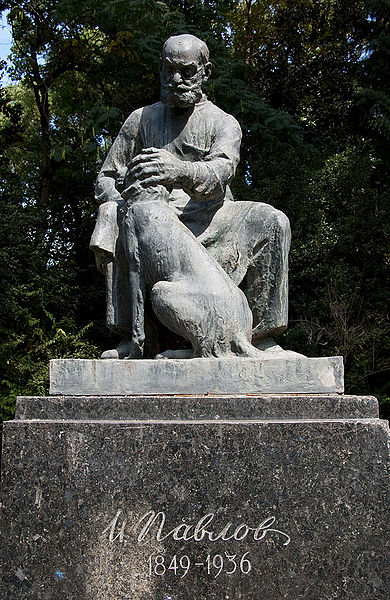
A statue of the Nobel Prize-winning physiologist Ivan Petrovich Pavlov (1849-1936), Institute of Experimental pathology and Therapy, at Sukhumi, Caucasus.
Classical conditioning (also called Pavlovian Conditioning) was made famous by Ivan Pavlov when he revealed the "conditioned reflex" of salivations from his dogs. Pavlov, the "master" was able to dominate his 'dogs' by conditioning them. Classical conditioning is a powerful tool mostly in favor of the marketers (masters) and not so much in favor of the consumers (dogs). Sorry!
Source Photo: Я автор этой фотографии (Wikipedia)

Tuesday, November 12, 2013

MAISON J.R. BRILLET CREATES COGNAC AMUNDSEN FOR THE NORWEGIAN LIQUOR MARKET

When I was a teenager I dreamt of being an explorer like Indiana Jones, Neil Armstrong, Jack London, or Roald Amundsen etc.
Perhaps, Amundsen more than anyone else because he proved to be the most resilient. He was the least likely to succeed according to its critics, a perfect underdog, and the most patient, perhaps enjoying the greatest popularity after his death. He was the first to use sled dogs for his expedition and constantly innovated to survive in his environment.
Roald Amundsen
Roald Amundsen
Maison J.R. Brillet, for the Norwegian liquor market, created a series of cognac named Amundsen. "In the design concept we went back to the roots, back to nature, and accentuated the taste by using the colors, shapes and movements from the grape fields and from the production" says Per Erik Larsen, the designer.
Cognac Amundsen, for Norwegian Liquor Market by Brillet
Amundsen Cognac
Amundsen Cognac
Amundsen Cognac
Amundsen Cognac
Amundsen Cognac
Amundsen Cognac
The project was in collaboration with Allegro Tønsberg. Amundsen cognac are now available in the norwegian liquor stores.
Sources: Per Erik Larsen

Tuesday, October 22, 2013

CHANGYU PIONEER WINE PURCHASED COGNAC ROULLET-FRANSAC


Changyu Pioneer Wine Co Inc, more commonly recognized under Chateau Changyu or simply Changyu is the oldest and largest winery in China. In the past 10 years, it has developed an impressive number of partnerships with the most significant being with the French Castel group which dominates the French production of wines in volume.
Changyu Logo
Changyu Logo
Hence, this company has a very European style in everything it does: Chateau Castels and Chateau Moser are buildings constructed like European castles but using the most advanced production methods.
Personally, I was impressed the first time I saw a bottle of wine produced by Changyu as I could see a right the balance of things on it to make me feel comfortable and familiar with, and a touch of details just enough to remind me it was Chinese.
Changyu Pioneer Wines
The big news these past few days is that Changyu just purchased Roullet-Fransac, a small cognac negociant whose business was slowing down. These past 5 years, Georges Roullet had mentioned he was selling its business including the impressive property on the docks of Cognac, corner of rue Saulnier and Quai des Flamands, direct neighbor with the impressive headquarter of Cognac Hennessy.
A few months ago some Armenians almost made a deal but it fell apart and I knew that this business would go to an impressive and large Chinese wine & spirit business. It was obvious! Roullet-Fransac were savvy in getting the property from the Firino-Martell years back when this family passed the relay to Pernod-Ricard, and now the world economy is such than the Chinese are leading the expansion. Cognac has never really been totally French. Many cultures have influenced the advance and stability of Cognac/ cognac: the Dutch, the English, the Russians, the Japanese, the Rappers and now the Chinese.
The newspaper the Sud Ouest has had a poll where 90% of the people have voted that they were worried that this was going to be a loss more than a gain for cognac (www.sudouest.fr).
This news brings two things: (1) people including Chinese are investing in cognac, and (2) Hennessy might not be the biggest company in Cognac anymore but it could be Roullet-Fransac now!

Thursday, October 10, 2013

CL WORLD BRANDS SELLS COGNAC HINE TO EDV SAS. WHAT HAPPENS TO DAVIDOFF & MONNET COGNACS?


2013 is  an important year for Hine:
(1)  Hine celebrates its 250th anniversary,
and (2) Hine was for sale and found a new owner.
It was in the air for the past  3 years as CL World Brands, which operates as a subsidiary of CL Financial, was going through some difficult times.
In 2009, Struggling Caribbean company CL Financial Limited came under the management of the Trinidad and Tobago government following a bail out.
Founded in 1763, Hine specialises in vintage Cognacs, which are released in limited quantities after a minimum ageing.
Hine Cognac, Product Portfolio
Hine Cognac, Product Portfolio 
In 1962, Hine was granted a royal warrant from Queen Elizabeth II, as suppliers of Cognac. It is still the only Cognac house to this day. I see Hine as the most British brand of cognac. Although largest brands are pretty much all connected to this part of the world (i.e. including Ireland). That is Hennessey, Martell, Remy Martin, Courvoisier, Hine, Hardy, etc. Why so many Anglo-British brand?
Well, they historically were the largest consumers. And my personal take is they were the best businessmen too! Hence, the designation for cognac VS (very special), VSOP (very superior old pale), and XO (extra old). Originally, the designation were in French: fine cognac (=VS), vieille fine cognac (=VSOP), and Hors d'Age (=XO). But these designations did not mean much in the native languages of the majority of the consumers which explains why English designations became the norm. Some brands still uses the French designations. Comandon Cognac for instance uses both French and English, see below.
Comandon Cognac Very Superior Old Pale, Vieille Fine, VSOP
CL World Brands, which operates as a subsidiary of CL Financial, has completed the sale of Thomas Hine and Company Cognac house to EDV SAS for an undisclosed amount, estimated at 60 million of Euros according to the newspaper Charente Libre.
EDV SAS, a French firm, is managed by the descendants of the family behind wine trader and retailer Établissements Nicolas. So at the end, Hine can celebrate its 250th with a big Cocorricco, since the brand is back to French ownership!
Logo Magasin Nicolas
Commenting on the transaction, EDV SAS was quoted by guardian.co.tt as saying, "Our strategy is to pursue the development and outreach of the Hine brand, in preserving its exclusive positioning on the market and the exceptional quality of its products, as well as in perpetuating the traditional values of its founding family."
Something there is no doubt Bernard Hine is appreciating!
Nicolas is a reputable retailer of fine wine & spirits established in Paris since 1822. Hine will be a good asset to Nicolas and vice and versa.
Earlier this year, CL Financial sold Appleton rum to Campari (Italy) and Burn Stewart Distillers to Distell (South Africa).
Hine Cognac's product portfolio includes Hine Rare VSOP, Hine Antique XO, Hine Jarnac-matured Vintage Cognacs and Hine Early-Landed Vintage Cognacs with an annual turn over of 14 million euros.
However, one has to wonder what will happen to Cognac Davidoff, a licensed brand which Hine just recently acquired from Hennessy, and also Cognac Monnet which were additional brands which Hine owned!
Source Photos: www.hinecognac.com